
About twenty years ago, we proposed making mBank's public information website look like Google.
A white page. The logo, still with its flower. One search box.
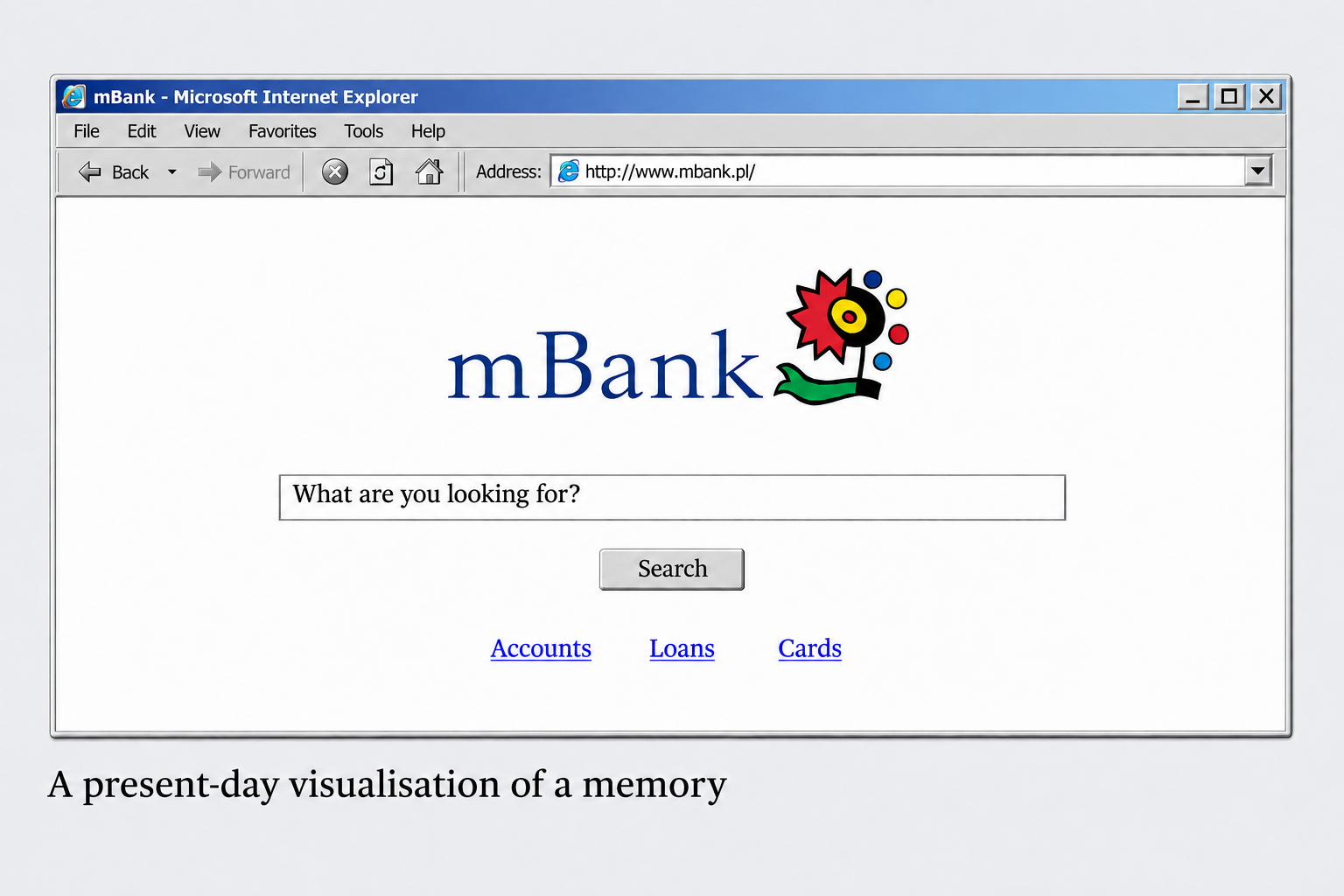
Figure 1. A present-day visualisation of the earlier concept — mBank's public information website as a single search box, shown in an Internet Explorer window.
There was Google technology behind the concept, too. At the time, the company sold server appliances with software for indexing and searching corporate content and websites. That was how Google Search Appliance worked.[1][2] As I remember it, mBank had bought a solution of this kind, and we wanted to build our idea around it.
The idea was a simple experiment. A visitor would type what they were looking for, and the site would help them find information about products, services or how to get something done. They wouldn't have to learn their way around the entire website first.
The proposal went no further. Today, I'm not sure whether it ever reached the bank's most senior decision-makers. It may have stopped at director level. In any case, we couldn't persuade the organisation to try the experiment.
Why I come back to it
I think back to it when I look at the development of conversational interfaces and AI assistants:
- "Which account should I choose for a small business?"
- "How much does it cost to use my card abroad?"
- "What documents do I need to apply for a loan?"
These are examples from today, but they capture the idea well. People know what they need. They learn the bank's product names and menu structure later.
Today's technology is much better at understanding a question, asking for context and bringing together information from several places. BBVA is developing its Blue assistant in this direction,[4] while Bank of America's Erica helps customers with a growing range of banking needs.[3]
What hasn't changed in twenty years
For a public information website, the essential question remains simple. Can people quickly find a reliable answer? Can they understand the terms, see up-to-date fees and reach the relevant source?
One box on a screen requires:
- well-organised content,
- current information,
- a sensible way to guide people to the next step.
Today, we have more tools to do that well.
Looking back, I wonder how many similar ideas have stalled inside organisations before anyone had a chance to run a small test with users.
I'd gladly revisit that experiment today.
Sources checked as of 2026-11-15. The author's recollection is the source for the note about mBank purchasing a Google device; the exact model is not established. Google Search Appliance is given as an example of Google's hardware-and-software technology of the period.